
Crossout explained: cabins, energy, tonnage and power score
Advertising disclosure
This page is paid for by advertising. Every button marked partner link goes to a commercial partner of BETOPOL s.r.o.. If you download or register through one of them, we are paid a commission. You pay nothing extra, and the commission does not buy a favourable review — the section on what the game costs is deliberately the least flattering part of this page.
We are an independent publisher. We are not affiliated with, endorsed by or sponsored by Targem Games or Gaijin Entertainment, and nothing here has been approved by them. Our funding, sourcing and corrections rules are set out in the editorial policy.
Most Crossout guides tell you which gun is strong this month. That advice expires. This one covers the four numbers the game is actually built on — energy, tonnage, mass limit and power score — because those constraints have not changed, and once you can read them, you can judge any build, including the ones a patch invents next year.
What Crossout is
Crossout is a free-to-download vehicular combat game with an unusual central idea: you do not pick a vehicle from a list, you build one out of parts, and then you drive that thing into a match against other people's home-made machines. Parts come off when they are shot off. A player who loses their weapon mount loses the weapon, keeps driving, and can still ram.
| Item | What the public listings say |
|---|---|
| Developer | Targem Games |
| Publisher | Gaijin Entertainment (shown on the Steam listing as Gaijin Network Ltd) |
| Genre | Vehicular combat, multiplayer |
| Open beta | 30 May 2017 |
| Steam release | 26 July 2017 |
| Platforms | Windows, PlayStation 4, PlayStation 5, Xbox One, Xbox Series X and S. A separate mobile game, Crossout Mobile, appeared on iOS on 10 February 2022 |
| Price | Free to download, with in-app purchases |
| Age rating | The Steam listing shows an ESRB rating of Teen. Ratings differ by region and can change with content updates, so check the rating displayed in your own store before buying anything |
| Anti-cheat | The Steam listing declares BattlEye, a kernel-level anti-cheat driver. If you object to kernel-level software on your machine, decide that before installing |
| Official site | crossout.net |
What this page will not tell you
It will not give you a tier list, a "best build", or a figure for how much damage any weapon does. Those numbers are balanced and rebalanced by the developer, and a guide that prints them is wrong within a patch or two. Everything below is about structure, which lasts.
How a vehicle is assembled
A build is six groups of parts bolted to each other. Understanding the groups is most of the battle, because the game's whole difficulty comes from the fact that these groups compete for the same limited budgets.
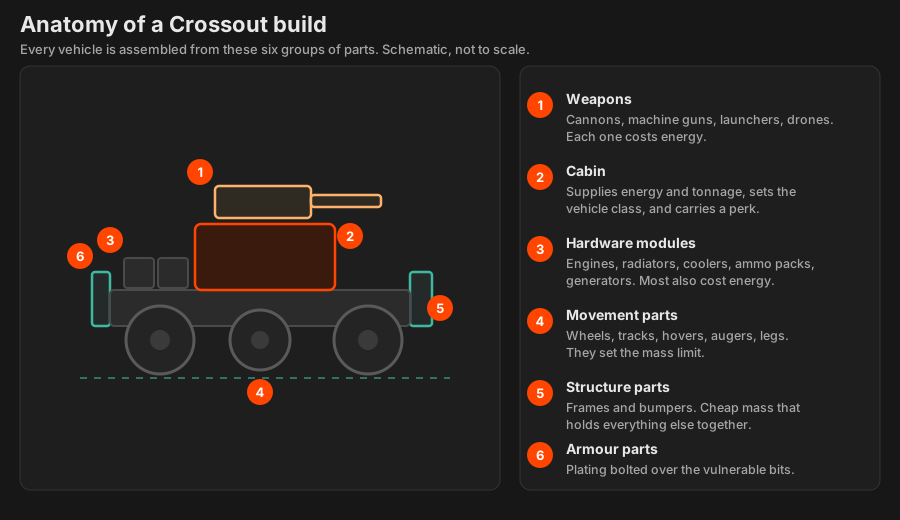
The important consequence is physical. Parts have positions, and positions are hitboxes. Two builds with identical parts lists can perform very differently because one of them buried its cooler behind armour and the other left it on the roof. This is the part of Crossout that no statistics screen can show you.
BETOPOL s.r.o. earns a commission if you act on this link. It costs you nothing extra and it does not change a word of what this page says.
The cabin sets the rules
The cabin is the single most consequential choice in a build, and new players routinely treat it as an afterthought. It supplies four things at once:
- Energy — how much weaponry and hardware the vehicle may carry at all.
- Tonnage — the weight at which the vehicle's acceleration begins to suffer.
- A class — light, medium or heavy, which shapes speed and mass allowances.
- A perk — a conditional bonus that usually implies a whole playstyle.
That last point is the one worth internalising. A cabin perk that rewards standing still and a cabin perk that rewards constant movement are not two flavours of the same thing; they are two different games. Picking the cabin last, after the guns, is how people end up with a vehicle whose perk never triggers.
Energy: the real budget
Energy is the constraint that stops Crossout from being a game about stacking guns. The cabin supplies a fixed number of energy points. Weapons consume them. So do most hardware modules: engines, coolers, radiators, ammo packs, generators. When the budget is gone, nothing else fits, no matter how much room is left on the frame.
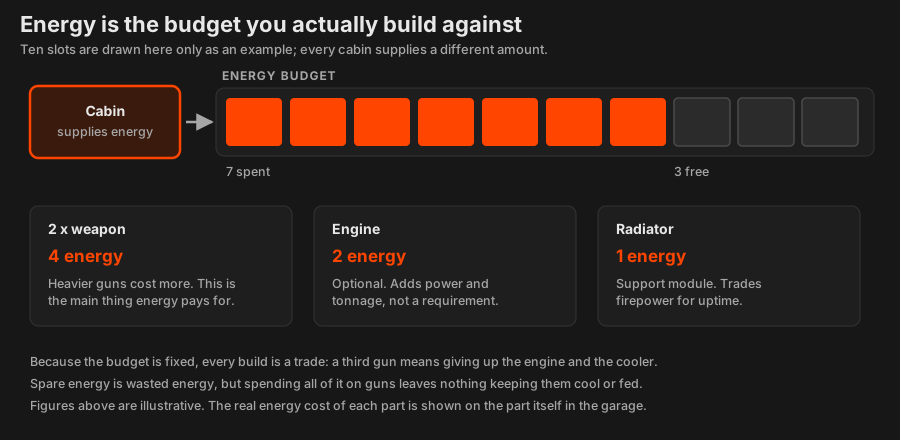
This turns every build into an argument with itself. A third weapon means no engine. A cooler that keeps a machine gun firing means one fewer gun to keep cool. There is no configuration that wins the argument; there are only configurations that lose it in a way you have chosen deliberately.
The most common energy mistake
Leaving energy unspent. Spare capacity does nothing. If you finish a build with a point free and cannot find a module worth the point, the build is probably carrying a weapon that is cheaper than it should be for the job.
Tonnage and mass limit are different numbers
These two get confused constantly, and the confusion produces vehicles that technically exist and practically cannot fight. They measure different things and they fail in different ways.
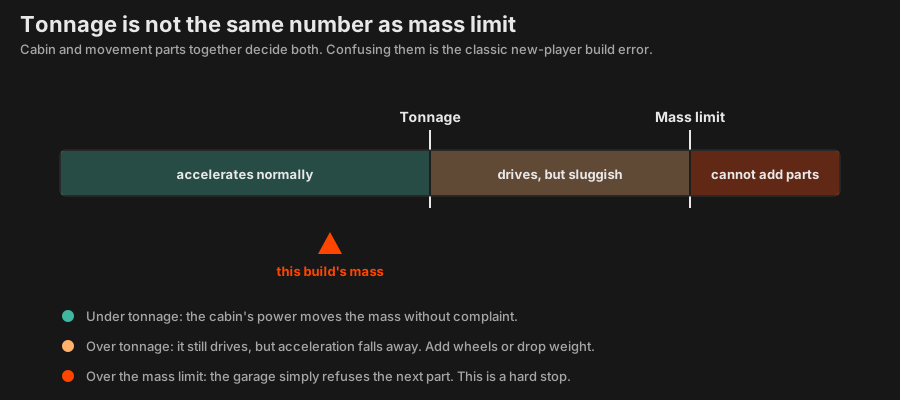
Tonnage is the weight beyond which the cabin's power can no longer move the mass cleanly. Cross it and the vehicle still drives, it just stops accelerating like something you would want to be sitting in. It is a soft, sliding penalty, which is exactly why people miss it: nothing tells you off, the car is simply a bit worse, and then a bit worse again.
Mass limit is what the movement parts can support. It is a hard stop. Reach it and the garage refuses to attach the next part. Adding wheels raises it; adding armour eats it.
Movement parts do more than move you
Wheels, tracks, hovers, augers and legs are not interchangeable chassis options. Each changes the vehicle's mass limit, its handling model, and the size of the target it presents. Wheels can be shot off individually and the vehicle limps. Tracks absorb a great deal of damage across their whole length before performance drops. Hovers handle unlike anything with ground contact and demand a different build discipline entirely.
Because movement parts set the mass limit, they are also the usual answer when a build is too heavy: the choice is drop armour, or add wheels and accept the extra power score. Which brings us to the number that governs everything.
BETOPOL s.r.o. earns a commission if you act on this link. It costs you nothing extra and it does not change a word of what this page says.
Power score decides who you fight
Every part carries a power score value. The vehicle's power score is the sum of its parts, and that total is what matchmaking uses to choose your opponents.
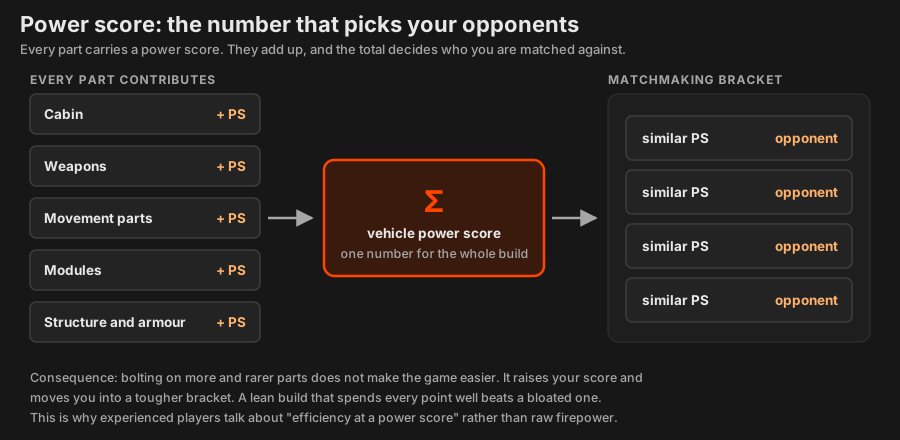
This is the mechanic that makes Crossout counter-intuitive for anyone arriving from a game with linear progression. Bolting on more parts, or rarer ones, does not make you stronger relative to your opponents. It moves you up into a bracket where everyone else has done the same thing, and quite often it moves you up faster than your skill has moved.
The healthy instinct, once this clicks, is not "what can I add?" but "what is this part earning me for the score it costs?" Experienced players talk about efficiency at a power score rather than firepower, and they are not being clever: it is the only comparison the matchmaker lets you make.
Light, medium, heavy
Builds sort themselves into three rough archetypes. None of them is the correct answer.
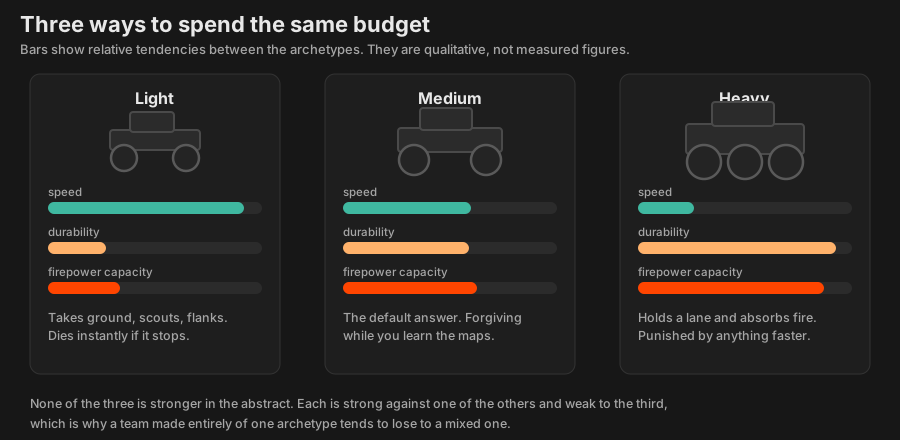
A light build takes ground and dies the instant it stops. A heavy build holds a lane and is helpless against anything that can choose the range. A medium build is worse than both at their own jobs, which is precisely why it is the sane place to learn: it punishes you less severely for being in the wrong place. Teams made entirely of one archetype lose to mixed ones, reliably.
Choosing weapons: four questions
Rather than a tier list that will be wrong by next season, four questions that will not be:
- What does it cost in energy? That cost is paid out of the same budget as your engine and cooling. A cheap weapon that lets you fit a module may beat an expensive one that does not.
- What range does it want? Range dictates your build's speed, its armour layout and where you can afford to be on the map. Fit the vehicle to the weapon's range, not the other way round.
- What does it need to keep working? Heat, ammunition and reload all have module answers, and those answers cost energy and weight. A weapon's real cost includes its support.
- How big a target does mounting it make you? A weapon that must sit high to fire also sits high to be shot.
Rarity and crafting
Parts sit on a rarity ladder. Community documentation lists seven rungs — Starter, Common, Rare, Special, Epic, Legendary and Relic — with higher rungs performing better and costing considerably more to obtain. Parts are crafted at faction workbenches using resources earned in play, and the factions gate what you can make.
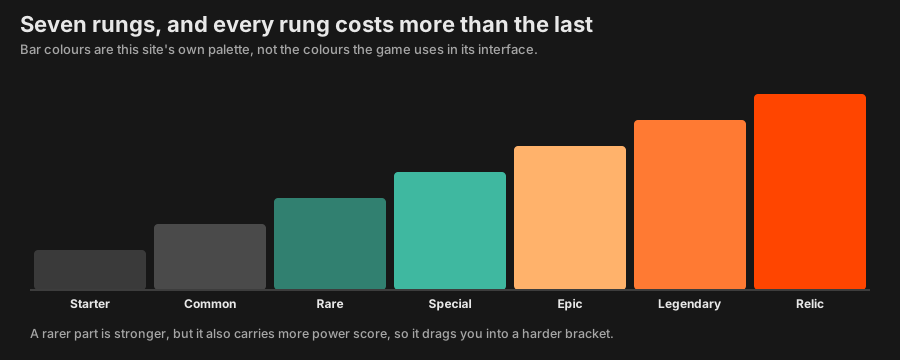
Rarity interacts with power score in the way you would now expect: a rarer part is better, and it also pushes you into a harder bracket. Upgrading one part of an otherwise modest build is a recognised way to make your own life worse.
The market, and where real money actually enters
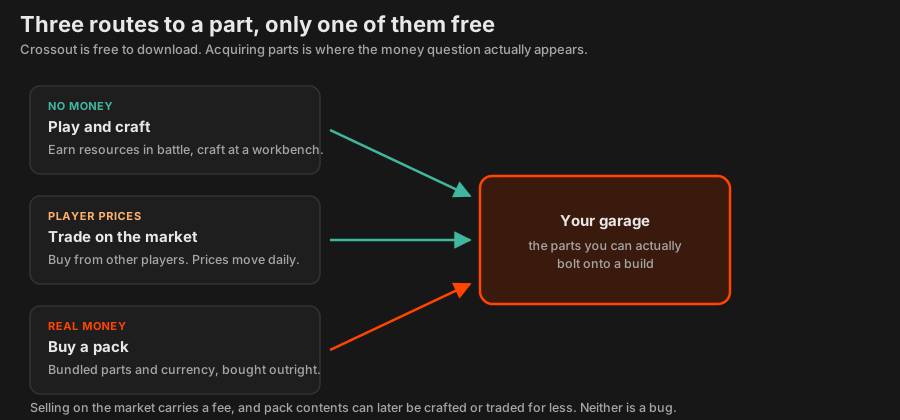
Crossout has a player-driven market where parts are traded between players for in-game currency. This is the feature that makes the economy interesting and the feature that deserves the most caution, because it is where a free game stops being free.
Read this before spending anything
- The game is free to download and contains in-app purchases. That is stated on the store listing.
- Market prices are set by players and move. A part that looks like a bargain this week may be craftable for less next month, and the reverse.
- Selling on the market carries a fee. Factor it in before treating trading as a way to fund your garage.
- Pack contents are frequently obtainable later by crafting. Buying a pack buys time, not exclusivity, unless the pack says otherwise.
- Nothing about the progression is guaranteed. Anyone promising you a specific in-game result for a specific spend — including any advertisement — is telling you something they cannot know.
Game modes
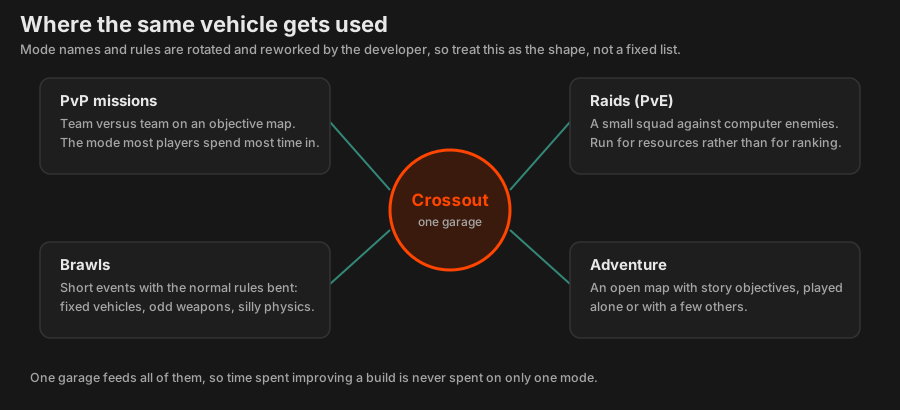
One garage feeds every mode, so time spent improving a build is never spent on only one of them. The developer rotates and reworks modes regularly, so treat the following as the shape of the offering rather than a fixed menu.
Five expensive beginner mistakes
- Choosing the cabin last. The perk should have shaped the build. Instead it sits there never triggering.
- Chasing power score. Every part you add picks a harder opponent for you. Build lean until your skill is the thing holding you back.
- Confusing tonnage with the mass limit. The garage will happily let you make something that drives like wet cement.
- Armour everywhere. Armour is mass, mass is tonnage, and tonnage is acceleration. Armour the parts that lose you the fight when they die, and leave the rest.
- Buying before understanding. The market is not going anywhere. Learn what you actually need first; the part you wanted in week one is rarely the part you want in week four.
BETOPOL s.r.o. earns a commission if you act on this link. It costs you nothing extra and it does not change a word of what this page says.
Sources and method
This page was written by consulting the game's own public store listing and publicly available reference material, and by describing mechanics that are structural rather than numerical. Where a figure would go out of date within a patch, we have deliberately not printed one. Where we were not able to verify something, we have said so in the text rather than filling the gap.
If anything here conflicts with information published by the game's developer or publisher, their information prevails. If you spot an error, tell us and we will correct it and say that we did — the procedure is in our editorial policy.
Sources consulted
- Crossout on Steam — developer, publisher, release date, free-to-play status, in-app purchase notice, ESRB rating and anti-cheat declaration. store.steampowered.com/app/386180/Crossout/
- Crossout, English Wikipedia — platform list, open beta and mobile release dates, mode overview, description of cabins, movement parts and the power score sum. en.wikipedia.org/wiki/Crossout
- Crossout official site, for current modes, updates and store terms. crossout.net
- Community reference documentation was used for the rarity tier names and for the tonnage-versus-mass-limit distinction. Community sources are not authoritative and are flagged as such wherever they are relied on above.
Corrections made to the earlier version of this page
An earlier version of this article was published without a byline or date and contained claims we could not stand behind. We removed the assertions that the game had "redefined the genre" and that its customisation was "unmatched", because neither is verifiable. We removed the claim that a player chooses "every component from the engine to the armour plating", because an engine is an optional module in Crossout rather than a required part. We removed a call to action reading "see why Crossout is better", because we cannot substantiate a comparative superiority claim. We removed a footer notice describing the article as a reader-submitted story, which it never was. The whole page has since been rewritten and sourced.
Independence: Crossout is a trademark of its respective owner. This website is independent: it is not affiliated with, endorsed by, sponsored by or approved by Targem Games, Gaijin Entertainment or any other rights holder named on it. All product names, logos and brands are the property of their respective owners and are used here for identification only.